Saturday, 2 March 2013

Wicken Fen: 'haunt of much wild life'


 The National Trust has been involved at Wicken Fen in Cambridgeshire for almost as long as we’ve been in existence. At a meeting of the General Committee, held on 26 April 1899, Mr Goss reported on the importance of the wetland site – ‘it was the haunt of much wild life and of the rare swallow tailed butterfly’. 
 
Minutes of National Trust Committee April 1899 on Wicken Fen
The following year, two acres were purchased through the generosity of Charles Rothschild among others, giving the Trust its first ever nature reserve. Acquisitions like this helped to meet the purposes of the organisation, as set out in the 1907 Act of Parliament, which included the preservation of the ‘natural aspect features and animal and plant life’ on Trust-held land.

Wicken fen, with one of our boardwalks

A century after our first acquisition at Wicken we launched a vision for transforming the landscape in the longer term. For the next 100 years, we are committed to acquiring further landholdings around Wicken, in order to return them to something like the original wetland landscape that would have been more common here before the fields were drained for agriculture.
Grazing pony

It is a bold vision, conceived on a wide scale and for the long term, in the expectation that it will dramatically enhance the diversity of animal and plant life already found at Wicken as well as provide fantastic outdoors experiences.
Lord Fairhaven rescued this pump

When I visited this week I found that much has already been achieved. Land has been taken in and allowed to return to wetland. The management of this land is largely carried out by herds of wild konik ponies and hardy highland cattle, roaming free across the open expanses and able to withstand the temperatures and weather conditions on the fens.

Wild horses take us here

The landscape is being opened up for access too. A cycle path now connects Wicken with nearby Anglesey Abbey. Cycles are available to hire, and cycle hoops dotted around nearby villages help to connect up the landscape as a whole – a nice touch. The new bridge at Burwell is an attractive feature in the landscape which also helps to connect up land across the lode.

The exciting thing about Wicken is… we don’t know what is going to happen next! It is a genuine experiment, and we wait to see what will happen as a result of these subtle but important changes to the landscape. So far the results have been spectacular with thousands of over-wintering wild fowl using the site. Clouds of Wigeon and Mallard as well as waders and Coots now all use the site.
The view from Burwell Bridge - wetlands to the right, agricultural land to the left

In the week when our new DG was in the news for her comments on wind turbines in the landscape, it was also good to see Wicken’s own wind turbines on display. Near the visitor reception there is one of the original wind pumps, rescued and moved here by Lord Fairhaven (who gave us nearby Anglesey). Further beyond is a more modern version, a new wind pump funded by the Environment Agency, which helps to keep the fen wet and calcareous by moving around water from the lodes.
One pump...
... or two?

 I also learned some more new words: ‘slubbered’ (dredging the mud from the lodes, or water courses), ‘drove’ (rectangular blocks of sedge, harvested in rotation), and my favourite ‘dockey’ (lunch - because fen workers had their wages docked if they took a lunch break). More fen words can be seen here.

Thursday, 28 February 2013

Anglesey’s Secrets

Anglesey Abbey is well known for its winter garden. It is one of the few gardens in the country that comes into its own at this time of the year. The garden, laid out in the 1970s on land that was formerly a mere belt of trees, takes visitors on a twisting serpentine path.


 Every turn reveals a new colour or fragrance – it’s a multi-sensory experience, artfully curated by Anglesey’s talented team of gardeners led by Richard Todd. The finale of the path is a forest of silver birches– a fittingly breathtaking end to a magical garden experience.


The garden post-dates the era of Huttleston, 1st Lord Fairhaven, who died in 1966 and bequeathed the house and grounds to the National Trust. But it continues to convey the aesthetic attention to detail that characterised his residency of the house – where visitors were encouraged not to enter the library before 6.30pm, so as not to leave unnecessary indents in the carefully brushed carpet.

Fairhaven was the son of Urban Broughton MP, who also purchased Runnymede in Surrey in order to save it for the nation. Magna Carta and the famous meadow where it was agreed are remembered in the collections on show at Anglesey – a reminder of the symbolic importance that the document held for Anglo-American families in particular.


On a visit to Anglesey this week, I discovered a new word – galathophile. It refers to collectors of snowdrops, which are having a particularly good season at Anglesey this year. I had not realised quite how varied snowdrops were until my visit. Richard explained to me that there are 20 species of the bulb, but that through cross-pollination there are very many more hybrids and variants. Some of these are indigenous to Anglesey. Specimens are kept in secret dells in the garden, off the visitor route and away from the predations of any wandering galanthophile. Some bulbs apparently change hands for significant amounts of money – but you need to know what you are looking for.


Another quirky secret was this window, in the library – with graffiti left by various members of another family with close links to the Fairhavens. 
The Queen Was Here


Friday, 15 February 2013

North Norfolk Coast: crucible of ecology


There’s something very special about the East Anglian coast. It’s not just that there’s so much of it, a great bulging arc encircling Norfolk, Suffolk and Essex from the Wash to the Thames estuary. For those who live on or near the coast, it is a constant feature of daily life, defining the mood and character of places.
Wide open spaces at Brancaster

Jules Pretty celebrates the ‘luminous’ quality of this coastline, referring to the ever-changing but ever-dominant influence of the light here on the eastern edge of England. Another writer who has been inspired by this coast is the poet Kevin Crossley-Holland:

“I only guess where marsh
finishes and sky begins,
each grows out of the other.”

No-one living here misunderstands the power of the sea, and its mysterious, unpredictable ways. This year we remember the tragic floods of 1953, when so many people lost their lives to a North Sea storm surge that overwhelmed defences all around the coast.

Forty years earlier, a century ago, some very interesting things were happening on the North Norfolk coast. In 1912 Blakeney Point was acquired by the National Trust. Its acquisition was championed by Professor F W Oliver of University College London, who was drawn to the 12-mile shingle spit for its unique flora and fauna.
Prof FW Oliver of UCL - later a member of NT's Council

The lifeboat house at the end of the point is currently undergoing serious restoration work, to ensure we have wind- and water-tight accommodation for our seasonal staff and volunteers, and a place for walkers and nature enthusiasts to shelter and rest. It’s a fantastic example of our approach to looking after a historically, culturally and architecturally important building but at the same time; invest in it as a modern resource.
The Lifeboat House, undergoing restoration Feb 2013
Solar Panels for the Lifeboat House


The North Norfolk coastline was a crucible for the early years of ecological science. Oliver brought many of the leading scientific figures to join him here on field studies expeditions. I was delighted to discover, when I visited property manager John Sizer at our Blakeney office, that a certain ‘Mr Hunter’ had accompanied Oliver on one such visit in July 1912. He stayed on Blakeney Point in a tent, and joined the professor in studying the distribution ‘of each species of plant with esp. reference … to the plants of shingle & sand.”. I assume this was Sir Robert Hunter, the first Chairman of the National Trust, surveying the Trust’s soon-to-be-acquired property (our 49th). He would have been 68 at the time!
Early Field Studies camp at Blakeney Point. Was Robert Hunter in that tent?

I learned a great deal from my visit, about the infinite complexities of the relationships on the coast. Here in North Norfolk, especially at Brancaster, there is a strong culture of common rights, with 19 different rights registered under the Commons Act, such as the right to pick the local-growing samphire. (Coincidentally, Robert Hunter was the country’s leading expert on common rights and devoted a whole chapter in his 1897 book on the subject to the rights ‘Of Foreshore and Cliff’.)

Crown and state have strong interests too, with different ownership and regulatory regimes operating over the intertidal zone. This is a rapidly developing field – witness the current consultation on marine conservation zones – and makes life interesting for those, like John, who live and work here on the coast, having to hold these relationships in careful balance.

I was also struck by the sheer popularity of this stretch of coast. John reckons that 140,000 people visit Brancaster beach each year. That’s more visitors than most Trust properties get. It’s a huge challenge – keeping everything clean and tidy, providing car parks and loos to go along with the views. But also a huge opportunity for the Trust to show what we are here for, looking after our most special places and landscapes.

Our teams work tirelessly to strike this balance between access and conservation.  It’s something we do well, and something we must constantly keep under review. We know that these places need people and people need these places so encouraging a harmony for mutual benefit  is our main aim. I think we do it pretty well - Sir Robert, who was a strong advocate for both, would be proud of us!

Thursday, 31 January 2013

Spirits of Place at Sutton Hoo


Perhaps we had offended the king. We were stood on top of burial mound 1 at Sutton Hoo when a rain cloud suddenly blew in from off the coast and drenched us. That'll teach me to clamber over scheduled monuments with such enthusiasm (and also not to wear the right clothes for the outdoors).
 
The view from Mound 1
I was visiting Sutton Hoo in the company of Martin, property manager, finding out about what makes this such a special place. Luckily soon after the rain started falling we spotted Les and a team of volunteers in the woods, all heading for a wooden shepherd’s hut to take shelter. We were invited in while the squall died down.
Les's Shepherd's Hut at Sutton Hoo

Sutton Hoo is a fascinating place. But what is it? The wooden posts on arrival declare it to be a royal landscape, a burial ground of an Anglo-Saxon warlord (in around AD625). But it is also the scene of one of the most remarkable archaeological discoveries of the twentieth century.

The story of archaeologist Basil Brown and his investigations under the patronage of the landowner, Mrs Edith Pretty, is well known to many. Brown was supplanted halfway through the investigations in the summer of 1939 by a team of archaeologists from Cambridge University under Charles Phillips. The story is entertainingly retold in John Preston’s novel, The Dig­  - well worth a read.
Basil looks on while Charles Phillips' team carry on the dig in 1939

So much at Sutton Hoo oscillates between the real and the recreated, the old and the new, the past and the present. The visitor centre was opened around 11 years ago, and contains fascinating original pieces from the archaeological work that has gone on at the site. The rest is very high quality facsimile – swords, helmets and other metalwork.
The real thing: a sword taken from a burial at Sutton Hoo

Nearby Tranmer House, now open to the public, is just over a hundred years old and was built originally as a hunting lodge. From it, the burial mounds are directly visible. It is possible to imagine that the finds came to the dining room here after they were removed from the mounds in 1939. Martin has started thinking about how best to present the house, the visitor centre and the mounds themselves as a whole, working with a fantastically committed and welcoming team.
Sutton Hoo Visitor Centre: our new walk-through recreation of the ship burial

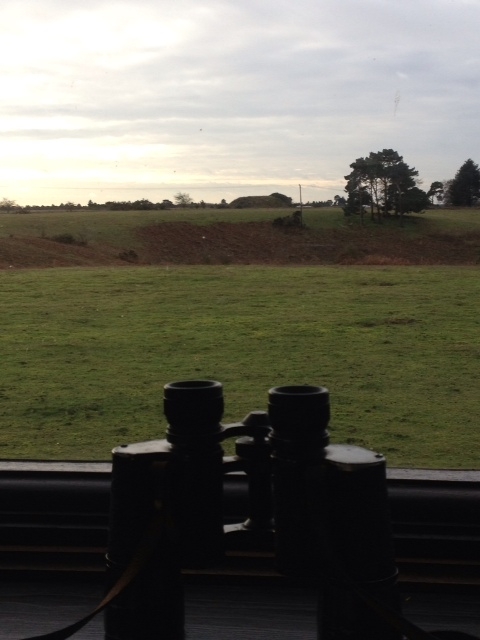
It was great to hear of the work underway to restore the view from Mrs Pretty’s sitting room, unimpeded by power lines. I loved seeing her binoculars on display and thinking of her gazing out here, before and during the archaeological investigations.
Mrs Pretty's binoculars, with Mound 2 in the distance

Mrs Pretty was a keen spiritualist, and it was said that she had seen spectral figures on the mounds, including a man on a white horse. Perhaps the binoculars have special powers, like those in the ghost story – helping to bring Sutton Hoo’s spirits of place to life.

Sunday, 27 January 2013

A visit to Houghton Mill


 A mill has stood on the river Ouse at Houghton since at least 969. That was the year Ramsey Abbey was granted the right to put up a mill, and demand that local farmers use it for making flour. It continued in use as a mill until 1929, when commercial operations came to an end. But the local people loved it so much as a landmark and picturesque spot that they came together to save it from disappearing. The building was, for many years, a youth hostel, albeit, from 1939, in the ownership of the National Trust.
Houghton Mill, January 2013

In 1998 substantial new investment was made in the site thanks to the Heritage Lottery Fund. A new mill wheel was added, and additional land and buildings purchased. Houghton Mill now welcomes many thousands of visitors each year, who come to see a working water mill in operation as well as enjoy the open meadows and river banks nearby.
The mill wheel, added as part of an HLF-funded Millennium project

When I visited this week, I had the great pleasure of being able to turn the handle that opened the sluice gate and started the mill wheel turning. It was a magical experience. I could physically feel the power of the water rushing through, adding resistance to the handle’s turn and starting to shake the timbers of the building. Flour soon started pouring out, and Steve, visitor services manager, explained how the different settings produced different grades of flour.
Steve at Houghton, showing me how the mill works

Sandy, a volunteer who works at the site, also showed me the secondary motor and mill stone that has been installed. This is a back-up, to ensure that flour can still be ground on days when the water levels prevent the main wheel from being used.  As Phil, ops manager, knows all too well, visitors to the mill above all want to see it in action.

My visit made me reflect on how our approach to industrial heritage differs from our attitudes to other sorts of heritage. A mill is a mill, regardless of the age of its individual components. The main building at Houghton today dates from the second half of the 18th century, with plenty of later additions.
Houghton, as shown on an early OS map

The team shared lots of conservation dilemmas with me: how to differentiate (or not) new woodwork from the existing timbers, how to manage visitor flows in some very tight and compact spaces. But the idea of installing new mill stones feels inherently right, even if those mill stones are not ‘original’. (Actually the new stones are French burr stones, manufactured by Kay & Hilton in Liverpool in 1859.)

I suppose Houghton Mill is therefore the Trust’s own version of Trigger’s Broom: how many times can you change the handle and head of a broom before it ceases to be the same broom? (Philosophers apparently refer to this as Theseus’ Paradox, after a story retold by Plutarch, so it’s not exactly a new conundrum.)

Anyway, the visit also reminded me of the power of bringing places to life. The mill really is a mill, producing flour from the natural power of the river’s flow. Phil and his team know that bringing Houghton to life means keeping the mill working. What’s more, I was delighted to be given a bag of Houghton flour, which I was able to take home as a memento. I am pleased to say it became some very tasty bread the next day.
Before
After


I cheated and used a breadmaking machine. But it’s still bread, as Trigger (or Plutarch) might have pointed out.


Thursday, 24 January 2013

Braving the Basement – Ickworth, Suffolk


 Part of my new role as director for the East of England region at the National Trust is to get to know all of the places that we look after in this wonderful part of the country. It’s a tough job, but someone has to do it…

And so to Ickworth, the first stop on my tour. I was here to meet Caroline, the general manager, and as many of her team as I could find on my first morning’s visit.

I was bowled over. I remember first visiting Ickworth around ten years ago, and have made several visits back since then, but in recent years the place has transformed beyond all recognition.

View of the Rotunda at Ickworth, in snow


The most noticeable feature now is the HLF-funded Ickworth Lives presentation in the basement. As Caroline explained to me, the innovation here is that new arrivals at the house are encouraged to visit the basement first, before they reach the grandeur of the rooms in the Rotunda. Unusually for country house properties, therefore, it’s more of a ‘downstairs upstairs’ experience than ‘upstairs downstairs’.

The sequencing helps to remind visitors that the Rotunda was, designed for entertaining on a grand scale and the basement was the engine room of the house – quite literally!. Some of Ickworth’s 400 or so volunteers add to the atmosphere by dressing in costume and showing visitors the sorts of jobs that were carried out in the basement.

 The presentation in the basement is made all the more poignant and affecting by the memories of people who used to work on the estate for the family, the Herveys. Three of them visited for the opening, their first visit back since leaving service some time before the Trust took on the site in the 1950s.

I loved the little details – the bicycles for getting along the endless corridors, the original copies of 1935 newspapers, the working speaking tubes connecting the basement to the rooms upstairs. The house had been modernised in the early 20th century, including with electric lighting – some facsimiles of the original lightbulbs are in use, casting a very dim glow.

Caroline, General Manager, with Ickworth basement bike

 
Visitors are encouraged to make the transition from downstairs to the upstairs by observing some simple rules of etiquette. But the shift from the basement to the majestic entrance hall is quite stark, and Caroline is keen to look again at the whole experience of visiting the house and grounds. Very exciting plans are being prepared, which could see new parts of the estate developed and new visitor routes and tours.
 
 Much of the collection in the house was covered up for winter. It was certainly cold in the basement, and not much warmer higher up either. But the views from the upstairs windows were stunning.

David, premises manager, told me about the insulation work that had been carried out in the house, which has dramatically reduced the heat loss from the roof of the Rotunda. LED lightbulbs and a woodfuel boiler in the new visitor reception lodge are contributing to driving down fossil fuel consumption. It’s a good reminder of the need for us to think in smart ways about how we manage great estates like this – just as their original owners would have done.

Snowy park tree


David has also been behind a photography exhibition in the Court Room in the west wing. Some fantastic photos of Ickworth in the snow can be seen on our Facebook site too – they put my hasty smartphone snaps to shame.

My overall impression is that I loved what the team have done in terms of tone, story and experience. I can’t wait to see it in full flow once Spring returns. Ickworth has enjoyed generous funding for the basement project but it also struck me that ideas like this don’t take pots of money, just a way of thinking and desire to tell our stories in different and flexible ways.  It’s inspirational stuff, and a shining example of a great team working together.

www.facebook.com/Ickworth/photos_stream


Sunday, 6 January 2013

Twelfth Night Den Building at Wimpole


Today, 6 January, is Epiphany, and it is also the day when Christmas is celebrated in Armenia. (For Russians, Georgians, Serbians and Ukranians, Christmas falls tomorrow.)   

The 6 January is also known as Twelfth Night, and the end of the Christmas season in this country. In days gone by Twelfth Night was, according to Steve Roud, second only to Christmas day as a day of festivities and feasting.

But today it has completely lost this meaning. New Year’s Eve is now the second major party event of the Christmas season, and Twelfth Night is a damp squib by comparison. If anything, it is the day when normality resumes. If it hasn’t been already, the tree is taken down, and boxes of baubles and tinsel are returned to cupboards and lofts.

I tend to insist on only taking down our decorations on 6 January, though it turns out that I may be completely wrong: Twelfth Night could well mean, in fact, the eve of the Twelfth Day eg the night of 5 January.

On the other hand, there are those who maintain that Christmas does not end until Candlemas on 2 February, giving the tree a 40 day lease of life.

No matter! Today we celebrated Twelfth Day/Night by getting back to nature and participating in a den building event at Wimpole. Although the event was advertised for 5-12 year olds, we took four boys all aged under 5 (though one celebrates his fifth birthday in a few weeks).

The building took place in a belt of woodland on the edge of the park at Wimpole – presumably woods that Capability Brown may have had a hand in planting.

Here is photographic evidence of our den, from its rudimentary beginnings to its final form. Well, it was more of a shelter than a den perhaps... But a fun way to start the year, nonetheless.  It was especially impressive that this was the first time the event had been run – it was part of the National Trust’s 50 Things promotion (building a den is Thing number 4).


We all got incredibly muddy, especially as Wimpole is one of those massive estates where the park belt is some distance from the house (and there were lots of muddy sections on the path to navigate). 
Time well spent

In smaller places, the house nestles right up to the belt, but in grander houses owners took delight in placing the house slap in the centre of a vast parkland. From the house, the impressive avenue at Wimpole stretches way out into the countryside.

I had a particular interest in the visit, since I am soon taking up a new role as Director for the East of England region in the National Trust. I shall enjoy visiting Wimpole even more in 2013.

Happy New Year! Or, if you are reading this in Armenia, Merry Christmas.